
All you need to know about wisdom tooth
Should you have your wisdom teeth removed?
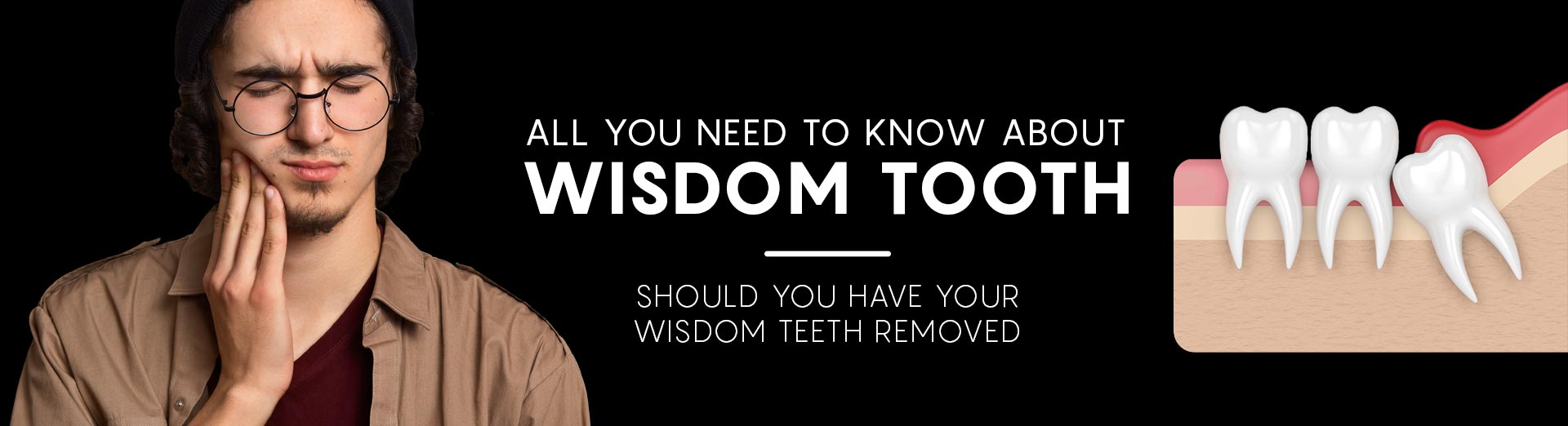
35% of people have no wisdom teeth. Are you one of them?
_______________________________
Does the wisdom tooth really give us “mind”?
These teeth were called “wisdom teeth” by our ancestors. They believed that wisdom teeth appear only to mature and wise people who have gained experience in life.
Each of us knows about the existence of these teeth, but few know the real reason for this name. Dentists call these teeth “third molars” because they are located at the very edge of the dentition in the upper and lower jaws of a person.
Wisdom teeth got their name because of the late eruption, which usually occurs between the ages of 18-30.

Why don’t we need the wisdom tooth?
Most scientists argue that wisdom teeth are unnecessary these days. Why? Humans adapted to eating soft foods and cooking them to the desired state, and learned to use a fork and knife to cut food into small cubes.
If we consider the anatomical structure of the jaw, then the presence of wisdom teeth is explained by the size of the jaw, which in our ancestors was much larger, about 12 cm. The function of wisdom teeth at that time was the same as that of other molars – chewing food.
Nowadays, people have smaller jaws, respectively the functionality of the wisdom tooth has been lost over time.
What problems can wisdom teeth create?
Wisdom teeth are often exposed to pathological processes and abnormalities. The wisdom tooth is difficult to clean because of its location.
The most common pathologies of wisdom teeth are:
- Dental caries, which can affect the neighboring tooth, and if not treated, trigger an infection. Caries occur as a result of the blockage of food debris, the difficulty of brushing the wisdom tooth.
- Dystopia – pathological process of tooth growth in an incorrect position, i.e. incorrectly located (in Greek dystopia means incorrect location, lack of space or tooth erupted in the wrong place).
- Partial eruption or complete preservation of the wisdom tooth in the gum, with a violation of the direction of growth and damage to the root system of the adjacent tooth.
- Pericoronaritis – a condition that occurs when the brain masses do not erupt completely, but partially. It affects the gum, and pain occurs during chewing. Thus, the gum becomes sensitive, and prone to the accumulation of food residues and bacteria.
Attention! It is not always possible to prevent the problems of wisdom teeth, because pathologies often begin to develop at an early stage, when the tooth has not erupted. For the purpose of prevention, a panoramic dental X-ray is recommended.

In these cases wisdom teeth extraction is not necessary
Not all patients agree with the extraction of wisdom teeth. As a rule, “3rd molars” can be saved if they erupt without complications, in the right place, without displacement of other teeth, etc. In this case, there is no indication of extraction.
Dentists have noticed that in some cases back molars can even be functionally useful. In people who have the neighboring tooth located at a certain distance from the wisdom tooth, the load of the jaw does not fall on the jaw bone, but on the wisdom tooth. The benefit is also noticeable if it is necessary to fix the prostheses, which in the absence of the tooth, are fixed on the saving teeth, that is – the wisdom teeth.
So, we have two types of lucky people: those who generally do not have wisdom teeth and those who have correctly positioned, healthy and pathology-free wisdom teeth.
However, if it is necessary to extract the wisdom tooth and it is not only abnormal but also endangers the neighboring tooth, then – follow the dentist’s instructions.

Do you keep your wisdom teeth?
Wisdom teeth that are not removed should still be monitored, as the potential to develop problems later still exists. As people age, they are at greater risk of health problems — and that includes potential problems with their wisdom teeth. Make sure you perform thorough hygiene and brushing, floss around your wisdom teeth and visit your dentist regularly. Regular dental appointments allow the dentist to assess the wisdom teeth and the general condition of the oral cavity (gums, teeth, etc.)
In any form and stage of the pain caused by the wisdom tooth, it is necessary to go to the dental office. Treatment at an early stage of the development of the pathology will be the most effective. Therefore, do not delay with regular preventive examinations.
If you have problems with your wisdom teeth, do not hesitate to contact Dentus•Dentino Dental Center. Our doctors, with +15 years of experience and international qualifications, will evaluate your wisdom tooth, detect the problem (maybe the wisdom teeth are not the cause) and offer an appropriate treatment plan.
I am writing and reflecting on my experience with wisdom teeth. All 4 of my teeth erupted and I had all of them extracted. All good and I am sure, wisdom teeth do not give us wisdom, but they create problems for us. Take care of your teeth 🙂